New Increases for Shelter Rates

Thanks to Disability Alliance Blog for this information:

The BC Budget for the 2023/2024 fiscal year was announced at the legislative assembly in Victoria on February 28, 2023. The Budget revealed that there would be an increase to the shelter rate for people on income assistance and disability assistance; an increase that has been long overdue. The shelter rate, which hasn’t changed since 2007, will increase from $375 per month to $500 per month for single individuals. Rent prices have increased by much more than $125 since 2007, so while we recognize that this shelter rate increase is a step in the right direction, it fails to meaningfully address systemic poverty in our province.

There are also increases to most income and disability assistance supplements, including diet supplements (increased by 50%) and the monthly nutritional supplement (increased from $165 to $180 per month). These changes take effect as of August 1st, 2023 (and will appear starting with the July 19th 2023 cheque issue).

The provincial government recently released a rate table, detailing current rates as well as the new rates. You can view this rate table here.

DABC has updated 8 of our Help Sheets to reflect the new changes to income and disability assistance shelter rates and supplements.


The updated Help Sheets are as follows:

Persons With Disability 

Checklist for the Persons with Disabilities (PWD) Benefit 

Monthly Nutritional Supplement (MNS)

The Persons with Persistent Multiple Barriers (PPMB) Benefit 

Health Supplements for People with Disabilities 

People with Disabilities on Reserve: The PWD Designation

Income Assistance Application Process for People with Disabilities 

Rate Amounts for Persons with Disabilities (PWD) and Persons with Persistent and Multiple Barriers (PPMB) Benefits 

If you have any questions, we have a ministry worker here on Wednesday and Thursday afternoons between 1pm – 4pm if you want to come by and speak to someone about your benefits.

Overcoming barriers and improving access

A view of the Penticton and Area Access Centre’s offices

For those in our communities who experience physical, social or economic barriers, accessing life-changing services can be a confusing and daunting task. The Penticton and Area Access Centre is working hard to change that, using the principles of action, awareness, advocacy and equity to help people navigate complex social systems.

“The barriers facing people who are seeking help from the Access Centre often feel very overwhelming to them,” says Brandi Beckett, Executive Director. “We believe the people we help deserve someone in their corner who says “we’ll figure this out together.””

When a person visits or calls the Access Centre for assistance, the team member who will greet them is their Triage Receptionist — a staff role the Community Foundation has funded for several years through its grant program.  The receptionist is an extremely important first point of contact for those seeking help: clarifying their needs, directing them to the right avenue of support and ensuring they are well prepared for subsequent meetings with the Centre’s advocates. The receptionist also has a positive impact on the Centre’s responsiveness by ensuring requests for help are addressed according to their level of urgency.

Perhaps most importantly, the receptionist provides valuable social and emotional support by helping to diffuse much of the anxiety and frustration people experience when trying to navigate access to services on their own. “By providing knowledgeable assessment of the circumstances surrounding each person’s request for help, the receptionist can quickly calm the situation and move it from uncertainty towards action,” Brandi says.

In 2022, The Access Centre provided help to over 5,000 individuals seeking assistance with a variety of needs including tax filing, poverty and family law concerns, and applications for disability supports. For more information about the Centre and its services, please visit their website.

Op-ed: Discrimination within the Canada Workers Benefit

By Alexandria Johnstone, Legal Community Impact Intern & Community Advocate: Resource, Referral, Youth Outreach, Disability & Poverty Law Advocacy
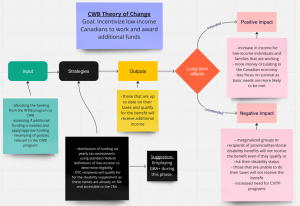
 

While the Canada Workers Benefit (CWB) has benefited some Canadians since its implementation, some individuals still qualify but cannot claim it due to its harmful effects. Indirect and direct discrimination against marginalized groups can be seen within this federal program, and it is high time for change.

Program Overview

The CWB is a program that provides a refundable tax credit through the Canada Revenue Agency (CRA) to help individuals and families that are both actively working and low-income (Canada Revenue Agency, 2023b). As defined by this program, low income has a net income of 33k/year for an individual and 43k/year for families (Canada Revenue Agency, 2023b). One may qualify for two possible CWB payments: the basic amount of $1428 for individuals and $2461 for families and a disability supplement of $737 for individuals and families receiving the same amount (Canada Revenue Agency, 2023b). However, only those approved for the disability tax credit (DTC) during the prior tax season can receive the CWB disability supplement, regardless of if they were receiving provincial disability payments or federal disability payments (Canada Revenue Agency, 2023b). According to the CRA, one is low income for those receiving DTC when one makes less than $37932 as an individual or $48124 as a family (Canada Revenue Agency, 2023b). If both spouses receive the DTC, those with a net family income of less than $53037 will qualify for the basic and supplement payments (Canada Revenue Agency, 2023b). However, only one CWB disability supplement can be received, regardless of both spouses qualifying (Canada Revenue Agency, 2023b).

Due to their similar goals, the CWB replaced the Working Income Tax Benefit (WITB) in 2019. The most noticeable difference between the two programs was that WTIB initially aimed to stimulate provincial economic growth while providing continued working incentives. In contrast, CWB aims to tackle this problem nationally (Canada Revenue Agency, 2020). The WTIB was provided to individuals with an income of over $3000 and below $32244 or under $42197 for families (Kubes, 2022). Although the CRA distributed payments, amounts varied for the WTIB payments as provinces calculated amounts given, with a max payment for an individual seen in BC of $1218 and a low of $665 seen in NU (Boat Harbour Investments, 2023). This program also had a disability supplement, which only those on both the DTC and provincial/territorial disability programs qualified for, which distributed $529 to each qualifying individual, except for in NU which only allocated $332 per person (Boat Harbour Investments, 2023). CWB is more efficient as increased amounts are given to all qualifying Canadians (Canada Revenue Agency, 2020). CWB was seen as an incentive for the working class due to decreased numbers in the workforce and increased living costs since WITB’s creation (Canada Revenue Agency, 2020).

Theory of Change

A theory of change assists in the program’s evaluation as it looks to explain how actions produce results that achieve intended impacts of an event, policy, program, or organization (Rogers, 2014). Through inputs (resources used) and outputs (direct or immediate effects on rightsholders), various intended and unintended outcomes, and impacts (positive, negative, primary, and secondary long-term effects) can be achieved (Rogers, 2014). Rightsholders are actors interested in the problem or issue, hold influence in or around it, or are affected via the end policy or program (Varvasovszky & Brugha, 2000). Networks and rightsholders are essential for the government to manage and realize goals, as some rightsholders have resources or capacities outside of what government bodies can offer (Pal et al., 2021). Successful policy implementation entails substantial degrees of private and public cooperation and interaction at every process phase (Pal et al., 2021).

There are two main categories to consider within discussions of rightsholders. The first is primary rightsholders with direct impacts or immediate concerns in the issue or proposed solution (Varvasovszky & Brugha, 2000). For example, in the flowchart, DTC recipients would be considered primary rightsholders as they are highly impacted by the CWB and will experience a direct impact from any changes made to the disability supplement.

The theory of change flowchart visually displays each step of the program’s creation in its attempts towards its goals so that an effective strategy can be created and possible outcomes. Note that the flowchart is not exhaustive, as this program require constant additions, reassessments, and analysis as new data is collected and changes are implemented. However, this analysis aims to identify strengths, weaknesses, and suggestions to create the best strategy to carry out the CWB and subsequent programs.

Additional impacts can also be seen from the chosen structure, implementation, and tools associated with the CWB. The flowchart displays the input into the program as funding and staffing resources. Strategies of the CWB would be the provision of payments and allocation of money. The direct effects of the CWB are payments received by those that are working and low-income in Canada, that are also up to date on their taxes. However, those that are unable to do their taxes or do not have a Community Volunteer Income Tax Program (CVITP) available do not receive the benefit(s), even if they qualify as the CRA has attached this payment to yearly tax assessments.

Impacts

The CWB program is beneficial as it provides additional income to low-income Canadians. However, this program has multiple barriers and adverse long-term effects for certain low-income groups. One negative aspect of the CWB is that if one is attending post-secondary, they do not qualify, even if they are working and low income (Canada Revenue Agency, 2020; Canada Revenue Agency, 2023b; Boat Harbour Investments, 2023), which does not incentivize post-secondary students to work while going to school, but rather encourages the opposite.

Another aspect of the CWB is that it assumes those that qualify for the payments will be able to do or get their taxes done. This is unreasonable as it does not acknowledge that low-income individuals are generally part of marginalized groups and require assistance (Reutter et al., 2009). If completion of taxes is going to continue to be how eligibility is determined, it would be necessary to increase year-round CVITP programming to remain equitable. CVITP is a CRA program that assists low-income individuals and families in filing their taxes at no cost (Beckett, 2022; Government of Canada, 2023). While the CVITP program currently exists, expanding the program would require additional planning, equipment, funding, and travel expenses (Beckett, 2022; Government of Canada, 2023), as well as additional volunteers able to attend remote and rural areas.

The WTIB’s requirement of being a part of a provincial disability program and the DTC created many barriers to access (Canada Revenue Agency, 2020; TurboTax Canada, 2022; Boat Harbour Investments, 2023). Each province holds different criteria for their respective disability programs, hence why disability designations are not transferable between provinces (Government of British Columbia, 2023). While it is no longer required to be a part of both programs (Canada Revenue Agency, 2020; TurboTax Canada, 2022; Boat Harbour Investments, 2023), if one receives DTC, provincial assistance, and CWB, they face their unique set of challenges.

Those on provincial social assistive programs are often penalized for receiving the CWB. While federal disability looks at one’s ability or inability to work (Government of Canada, 2022), the DTC and provincial programs look at the impacts of mental or physical conditions on one’s daily living ability (Canada Revenue Agency, 2023a; Government of British Columbia, 2023); therefore, they can work part-time if they have the capacity. Using BC as an example, one can only make 15k/year, including employment, EI, GST, or other means while receiving assistive payments (Government of British Columbia, 2023). As federal payments such as GST are not exempt from the earnings legislation under the Ministry of Social Development and Poverty Reduction (MSDPR), one could be penalized for going over the 15k allotment by receiving such payments (Government of British Columbia, 2023). Furthermore, once one exceeds the 15k allotment, they no longer receive any disability payments for the following year (Government of British Columbia, 2023), further perpetuating cycles of poverty and houselessness. More work must be done to ensure those on various provincial disability programs would not lose their disability designation due to a benefit incentivizing them to work, such as enforcing exemptions of federal government payments.

Suggestion

While the program met the needs of some low-income individuals, additional barriers made it difficult for all those that qualified to receive payments. An improvement that can be made to this program is applying a gender-based analysis (GBA) during the strategy or implementation phase would assist the CRA in avoiding the unintended negative impacts of the CWB program, as illustrated in the flowchart. In employing an intersectionality lens under GBA+, government entities like MSDPR and CRA, remain responsible for equitably filling gaps seen by low-income working Canadians.

Policymakers and analysts must consider why and how policies will affect diverse populations so that the following policies and communications can remain efficient and productive (Hankivsky et al., 2019). Pal et al. (2021) discuss the impacts of problems and proposed policy among various groups in society; the GBA and gender-based analysis plus (GBA+) will assist in discussions of oppression and marginalization of low-income groups, such as seniors and persons with disabilities. In addition, GBA+ focuses explicitly on policy implications for women, men, nonbinary persons, and other intersecting identities which have historically faced inequity (Pal et al., 2021).

Through using the GBA or GBA+, edits to the CWB program can be made to ensure all people that qualify receive payments without penalty, or movements toward a different program can be made. CWB is rooted in neoliberal idealism as it looks to incentivize Canadians to work, not considering other factors that have led to the decline in the workforce. The neoliberal era has typically placed one’s value on their ability to work and economically provide (Simon, 2001). A program such as universal basic income (UBI) would avoid the negative effects seen through the CWB; it would remain low-barrier and accessible to all Canadians as it would be equally distributed to citizens, regardless of disability status or tax completion. This would also lessen the costs associated with CTIVP expansion, funded by the CRA (Beckett, 2022; Government of Canada, 2023), as it would be necessary to improve the CWB program. One may also argue that a UBI may take away productivity, but no data suggests that the motivation to earn money would be reduced, especially within a capitalist society (Simon, 2001).

A UBI model in Canada would be much more efficient in spurring economic growth by allowing for discretionary income, incentivizing productivity, and assisting individuals in accessing universal needs like food and housing (Simon, 2001). However, neoliberalism perpetuates within current Canadian systems and a citizen’s value is linked to their ability work (Simon, 2001). Regardless of a CWB or UBI program being used going forward, all programs should employ GBA+ throughout the process to avoid additional barriers to recipients, starting in the strategy and implementation phases. The federal government should also ensure disability supplements can be received without risk to one’s provincial or territorial disability designation. Through collaboration between provincial bodies (like MSDPR in BC) and the federal government, benefits like the CWB can be optimized to ensure economic growth, while equitably incentivising all Canadians to work.


References

Beckett, B. (2022). Community Volunteer Tax Program: Program overview. Penticton & Area Access Centre.

Boat Harbour Investments. (2023). Line 45300 Canada workers benefit (CWB) refundable tax credit: Formerly working income tax benefit (WITB). Taxtips. https://www.taxtips.ca/filing/canada-workers-benefit.htm.

Canada Revenue Agency. (2023a, Jan. 24). Disability tax credit (DTC).  https://www.canada.ca/en/revenue agency/services/tax/individuals/segments/tax-credits-deductions-persons-disabilities/disability-tax-credit/eligible-dtc.html.

Canada Revenue Agency. (2023b, April 7). Canada workers benefit. https://www.canada.ca/en/revenue-agency/services/child-family-benefits/canada-workers-benefit.html.

Canada Revenue Agency. (2020). Canada workers benefit: Working income tax benefit before. https://www.canada.ca/en/revenue-agency/programs/about-canada-revenue-agency-cra/federal-government-budgets/budget-2018-equality-growth-strong-middle-class/canada-workers-benefit.html.

Government of British Columbia. (2023, March 1). MSDPR BCEA policy & procedure manual. https://www2.gov.bc.ca/gov/content/governments/policies-for-government/bcea-policy-and-procedure-manual.

Government of Canada. (2022). Canada pension plan disability benefits. https://www.canada.ca/en/services/benefits/publicpensions/cpp/cpp-disability-benefit/eligibility.html.

Government of Canada. (2023, Feb. 14). Free tax clinics: Through the community volunteer income tax program (CVITP), community organizations host free tax clinics where volunteers file tax returns for people with a modest income and a simple tax situation. https://www.canada.ca/en/revenue-agency/services/tax/individuals/community-volunteer-income-tax-program.html.

Hankivsky, O., Grace, D., Hunting, M., Giesbrecht, M., Fridkin, A., Rudrum, S., Ferlatte, O. & Clark, N. (2019). An intersectionality-based policy analysis framework: Critical reflections on a methodology for advancing equity. In Hankivsky, O. & Jordan-Zachary, J. (Eds.), The palgrave handbook of intersectionality in public policy (133-166). Palgrave.

Kubes, D. (2022). What is the working income tax benefit? Wealthsimple. https://www.wealthsimple.com/en-ca/learn/working-income-tax-benefit.

Pal, L., Auld, G., & Mallett, A. (2021). Beyond policy analysis: Public issue management in turbulent times. Nelson.

Reutter, L., Stewart, M., Veenstra, G., Love, R., Raphael, D., & Makwarimba, E. (2009). “Who do they think we are, anyway?”: Perceptions of and responses to poverty stigma. Qualitative health research19(3), 297-311. https://doi.org/10.1177/1049732308330246.

Rogers, P. (2014). Theory of change (Methodology Brief and Impact Evaluation No. 2). UNICEF Office of Research. https://www.betterevaluation.org/sites/default/files/Theory_of_Change_ENG.pdf.

Simon, H. (2001). UBI and the flat tax. In Widerquist, K., & Wispelaere, J. (Eds.), Basic income: An anthology of contemporary research (240-242). Beacon Press.

TurboTax Canada. (2022, April 1). Tax basics: How taxes work in Canada [Video file]. Youtube. https://www.youtube.com/watch?list=PL491SLBXGhzhdPw5vM-K E8G0FwhEhZag&v=jRfM94XHLwM&embeds_euri=https%3A%2F%2Fturbotax.intuit.ca%2F&source_ve_path=OTY3MTQ&feature=emb_imp_woyt.

Varvasovszky, Z., & Brugha, R. (2000). A stakeholder analysis. Health policy and planning, 15(3), 338–345. https://doi.org/10.1093/heapol/15.3.338.


Access Centre Success Story: Ted

TED*’S STORY:

One of the supports that poverty advocates provide is helping people connect to money they’re entitled to. It might not be a lot and it might be a one-time payment but if it means there’s more than there used to be, then it’s worth looking for. A lot of people we meet don’t know what they’re entitled to and they often don’t know how to apply for it, or maybe they tried but it didn’t work.

Like Ted. Ted is a senior living on a little over $600 month, which is a red flag when you understand federal benefits. Someone told Ted he made too much income to collect GIS so he thought he just wasn’t ever going to get it. Our advocate set up a three-way call with Service Canada and got a great agent who discovered that Ted’s GIS had never been applied for and that he was eligible to apply retroactively for three years. Once the applications are approved, Ted’s going to get a windfall and his monthly income will triple for the rest of his life.


*Name changed to protect privacy

Credit/Rebate updates

Assistance Extended for Ukrainians coming to British Columbia

BC Hydro Rebate

  • Eligible customers will receive a one-time BC Hydro credit between December and early 2023. This includes eligible customers who receive their electricity service from FortisBC or a municipal utility.
  • The credit does not need to be declared on provincial assistance recipients’ monthly reports.

BC Affordability Tax Credit

  • Eligible individuals and families will automatically receive the new BC Affordability Credit through the Canada Revenue Agency.
  • An eligible person with an income of up to $36,901 will receive the maximum amount of $410.
  • This Credit will need to be recorded on provincial assistance recipients’ monthly report under “all other income/money received”.
  • It is not considered income and is treated as exempt.

Self Employment Program

  • The Self Employment Program (SEP) policy under “Deductions and Exemptions” now allows personal contributions for Canada Pension Plan (CPP) to be deducted from gross income.

The government of Canada also recently announced two benefits administered by the Canada Revenue Agency (CRA). Both benefits are not considered income and are treated as exempt:

Canada Dental Benefit

  • The interim Canada Dental Benefit is intended to help lower dental costs for eligible families earning less than $90,000 per year for children under 12 years old receiving dental care who do not have access to a private dental insurance plan.
  • Depending on family net income, a tax-free payment of $260, $390, or $650 is available for each eligible child.

One-Time Canada Housing Benefit

• The one-time top-up to the Canada Housing Benefit aims to help low-income renters with the cost of renting by providing a maximum one-time payment of $500 for qualified applicants.

  • The deadline to apply for this benefit is March 31, 2023

Special thanks goes to Disability Alliance BC for this important information. Visit their website: About Us | DABC (disabilityalliancebc.org)

Human Rights vs. BC’s Mental Health Act

This is a great article from Disability Alliance’s Transition Magazine.
transitionfallwinter22.pdf (disabilityalliancebc.org)
Credit goes to KENDRA MILNE

Mental health advocates in BC have been sounding the alarm for decades: our Mental Health Act is one of the most archaic and discriminatory pieces of our ableist health care system.

Ableism plays out in mental health law and policy by reinforcing ideas that there are certain “normal” ways of thinking, interacting and participating in community. These ideas often reflect colonial and neurotypical lenses on the world.

BC’s Mental Health Act sets out when you can be admitted to hospital and treated for what the Act calls a “mental disorder” because either you ask for that care or because you are being detained and involuntarily treated.

The Act views and treats mental health issues as moral failings that can be disciplined out of people. This law impacts people diagnosed with mental illness, brain injuries, dementia, substance-use-related health issues, and many other disabilities or health conditions. The Act was passed in 1964 and many portions of it are the same today.

Every patient is subject to the direction and discipline of the facility staff. They can be confined in solitarily seclusion rooms, restrained to their beds, or otherwise punished during their time in hospital. There are no limits and no review on when, how or why someone can be subject to these restraints.

This is still true, even though a 2021 investigation into the Mental Health Act, by the Representative for Children and Youth, concluded there should be strict limits on restraints.

When any citizen accesses health care, the law protects our right to make our own health care consent decisions. If we are incapable of understanding and making a health care decision, the law protects our right to have the people who know us best make the decision.

That is, unless you are involuntarily committed under the Mental Health Act–then you have no such rights. All involuntary patients can be given any form of psychiatric treatment without consent and supporters are excluded from decision-making.

Other countries have acknowledged the need to modernize their mental health laws and have taken action. For example, Victoria, Australia’s recently tabled new Mental Health Act, rooted in human rights, ensures Indigenous people receive culturally safe services and establishes adequate oversight. The UK also commissioned an independent review recognizing that its mental health law entrenched systemic racism and relied heavily on coercion.

There is growing evidence that our Mental Health Act is not serving BC well and needs to be modernized to protect human rights and wellbeing. Emerging investigations from independent offices, and compelling stories from people and their families with experience of the mental health system, all point to the same conclusion.

BC needs an independent review of the Mental Health Act to create reforms that respect human rights, promote evidence-based care, and build in oversight from an independent provincial Mental Health Advocate.

KENDRA MILNE IS A LAWYER AND EXECUTIVE DIRECTOR OF HEALTH JUSTICE. LEARN MORE AT HTTPS://WWW.HEALTHJUSTICE.CA.


4 Books to Help Boost Your Mental Health

Image credit: Pexels

Source: https://www.pexels.com/photo/woman-in-yellow-long-sleeve-shirt-lying-on-couch-4866043/

As we continue to emerge from the anxiety, isolation, and grief of the past few years, we must try to be proactive in taking care of our mental health. We can begin by exploring the many books that focus on the topic. Books on mental health can be a fantastic resource for understanding the mind, how it works, and how we can take care of it. Although reading up on mental health is not a substitute for professional medical help, it can certainly be an entryway towards seeking support.

Dealing with a mental illness can be isolating, even though the National Institute of Mental Health reports that one in five in the United States lives with a mental health condition. Poor mental health challenges every person differently, and recognizing when you need to get help or offer support can help change this statistic for the better.

Books that cover the subjects of depression, anxiety, relationships, and self-care can supplement our mental toolkits through the techniques, research, and narratives of people who have studied and experienced the same hurdles. To get you started, here are four books that can help you boost your mental health:

1. The Body Keeps the Score

Trauma impacts both the mind and the body, compromising one’s capacity for pleasure, self-control, connection, and trust. In his bestselling book The Body Keeps the Score, trauma research author van der Kolk explores treatment methods that help activate the brain’s natural neuroplasticity in patients dealing with trauma. Neuroplasticity refers to the human brain’s ability to adapt to changes in its external environment.

Van der Kolk’s thesis is especially relevant now. We mentioned in our “Alone Together” blog post how tough it is to process distressing situations while they are still ongoing. Ultimately, The Body Keeps the Score stresses that understanding the functional and chemical changes in the emotional part of the brain can be key in improving ways to address our traumatic experiences.

2. Feeling Good: The New Mood Therapy

Through this bestselling classic, Dr. David Burns explored emerging approaches to psychotherapy such as Cognitive Behavioral Therapy (CBT). Feeling Good: The New Mood Therapy popularized CBT which Dr. Aaron T. Beck originally developed. Today, many psychiatrists utilize CBT in their treatment methodologies. This book also introduces scientifically proven techniques to help alleviate feelings that lead to depression or anxiety.

Apart from helping you lift your spirits, the techniques outlined in the book can enable you to overcome guilt, hostility, and criticism while building your self-esteem and encouraging positive feelings.

3. Radical Compassion: Learning to Love Yourself and Your World with the Practice of RAIN

Practicing compassion can be tough when our first instinct is self-preservation. Developing this trait can be a long process when difficult emotions and judgmental beliefs get in the way. To deeply ingrain compassion into one’s personality, psychiatrist and meditation teacher Tara Brach presents a meditation practice called RAIN in her book Radical Compassion: Learning to Love Yourself and Your World with the Practice of RAIN, which stands for “Recognize, Allow, Investigate and Nurture.”

This method of meditation starts by recognizing your current situation and allowing life to be just as it is. It is followed by a gentle and curious investigation of your experience. The practice ends with a call to nurture by offering yourself tender words or a kind embrace. Although this method does not claim to cure anxiety, RAIN prevents it from taking over.

4. Emotional First Aid

Mental health care has gained traction over the past decade, and rightfully so. Psychologist Guy Winch argues that emotional injuries are just as crippling as physical ones. In other words, mental health should be given the same urgency and attention as physical health. In his book, Emotional First Aid, Winch highlights various emotional wounds that are ubiquitous today, such as loneliness, rejection, trauma, and guilt.

Winch presents ways to “treat” these wounds and build emotional resilience through practical and realistic instructions. Emotional First Aid is a handy guide to have when things get rough because, as the title suggests, it’s not just physical wounds that require emergency relief.

The benefits of picking up a book on mental health care are immense, whether you are working on your own self-care journey or taking care of your loved ones. Through these books, you can gain a deeper understanding of psychology and mental health care while undergoing therapy or professional help.

Article written by Renee Jules

Exclusively for

Global Pandemic: Changes to How We Help

The Access Centre has been a drop in centre for many years, for our entire history really, even back when we were the Women’s Centre. Being open for people to drop in anytime during our business hours was the backbone of what we did. There were times when people would come in just to hang out in our lobby and take a nap in a chair because they didn’t feel safe outside. Our open door policy was how we set ourselves apart as a place where all are welcome, a place where anyone can have Access to support.

Then a global pandemic hit and we had to find a new way.

I’m sure anyone reading this can relate to the feeling of overwhelm associated with having to find new ways to do… well… everything. Suddenly, we were working mostly from home, trying to connect with the people we serve over the phone, passing along messages through online apps to stay in touch with our team. For some people, this was a pretty easy adjustment to make, for others, it meant learning many new skills. Those of us that were a bit more technologically savvy did our best to help our more old-school coworkers and together, we figured it out.

There were some particularly funny things we had to work around. I remember how ridiculous the phone tag would get! Someone would call us for help after hours and leave a message, the receptionist would listen to the message, and call them back to get the details, then forward it on to the appropriate advocate over an online messaging app. The advocate would call the person, and leave a voicemail. They would then call us back at the office and the receptionist would have to again-pass on the message to the advocate at home to try again. This could go on for days sometimes!

Something we learned from all this was that we could help some people better by using these remote tools. Folks who lived out of town, had mobility issues, or social anxiety all found it very difficult to come to our office for drop in and wait in a crowded lobby; now we can serve those people better. We were forced to learn new ways to work but it ended up being a benefit. Now we can tailor our services to the people we help to meet them where they are at.

We’ve slowly transitioned back to in-person services as it was safe to do so. Our advocates work a hybrid remote and in-person schedule and there are always several staff present each day. We’ve been meeting folks in our office since mid-2020 with safety protocols and by appointment only. Now we are open to drop in again on Tuesday afternoons for advocacy, Thursdays for income taxes, and meetings with government outreach workers Wednesday and Thursday. Folks can stop by anytime during business hours to look through donations, book an appointment, or ask questions. Our staff are doing outreach again at other organizations and in the communities of Summerland, Oliver, and Osoyoos.  It feels so good to connect with people face to face again and there are just certain people that have a really hard time making it to an appointment, maybe they don’t have a phone we can call them on, maybe they have a brain injury and can’t remember appointments, now they can drop in and get help in a way that works for them.

I don’t think we will ever go back to things the way they were. We’ve developed new ways to work and now have the flexibility to connect with people however works best. Though it was challenging and stressful at times, it made us better at our job-helping people that are experiencing barriers get access to the support they need.

Security Deposits: The Basics

There are often questions asked about how much a landlord is legally allowed to charge for a Damage Deposit or Pet Deposit. If you have further questions or feel you are being charged too much for your Pet or Damage Deposit, please give us a call to speak to one of our expert legal advocates at 250-493-6822 or email at support@accesscentre.org

The Basics

A security deposit – often referred to as a “damage deposit” – secures the tenancy for you and your landlord. Once you have paid your deposit, you cannot decide to move in somewhere else, and your landlord cannot decide to rent to someone else. If you pay a security deposit but do not move in, your landlord may be allowed to keep your deposit. You may even have to pay additional money to cover the cost associated with re-renting your unit, or to cover your landlord’s lost rental income if they cannot find a replacement tenant.


Security Deposits

According to section 19(1) of the Residential Tenancy Act, the maximum amount a landlord can charge for a security deposit is half the monthly rent. If your landlord requires a security deposit, you must pay it within 30 days of the date it is required to be paid. If your landlord believes you are responsible for damage beyond reasonable wear and tear, they can ask the Residential Tenancy Branch for permission to keep your security deposit.

Pet Damage Deposits

If you are allowed to have a pet, your landlord can require a pet damage deposit of up to half the monthly rent. This is the maximum amount a landlord can charge for a pet damage deposit, regardless of how many pets you have. You will have to pay this deposit either at the start of your tenancy, or when you get a pet at any point during your tenancy. If your pet causes extraordinary damage or unreasonably disturbs others, your landlord may try to evict you and keep your pet damage deposit. See TRAC’s webpage, Pets, and Residential Tenancy Branch Policy Guideline 31 for more information.

Guide dogs: If you have a dog that falls under the Guide Dog and Service Dog Act, your landlord must allow it and cannot require a pet damage deposit.


Applying Deposits Towards Rent: According to section 21 of the Residential Tenancy Act, you are not allowed to apply your security deposit towards rent without your landlord’s permission. For example, you cannot pay only half of your last month’s rent and tell your landlord to cover the remaining half with your security deposit, unless you have their written consent.

Overpaying a Deposit: The maximum amount you can be charged for a security deposit or pet damage deposit is half the monthly rent. If you have been overcharged for either, section 19(2) of the Residential Tenancy Act allows you to deduct the overpayment from your next month’s rent. Some landlords may not know that tenants have this right, so make sure to clearly communicate with your landlord if you decide to deduct rent for this reason. See TRAC’s template letter, Withholding Overpayment of Deposit from Rent. If you are not comfortable withholding rent, you can apply for dispute resolution to recover the overpayment.

Getting Your Deposit Returned: If you would like to have your deposit returned, the first step is to provide your landlord with a forwarding address in writing indicating where your deposit can be sent. See TRAC’s template letter, Return of Security / Pet Damage Deposit. Make sure to have evidence that you provided your forwarding address, such as a witness or registered mail confirmation. You should also have the option to list your forwarding address on the move-out condition inspection report.

Once you have provided your forwarding address in writing and your tenancy has officially ended, your landlord has 15 days to take one of the following three actions:

  1. return your deposit;
  2. get your written permission to keep some or all of your deposit; or
  3. apply for dispute resolution to keep some or all of your deposit.

Your landlord can return your deposit by delivering it in person, mailing it, leaving it in your mailbox or mail slot, or sending it electronically. If your landlord returns your deposit by electronic means, they are not allowed to charge a fee.

Your landlord cannot simply decide on their own to keep your deposit. If they want it, they need written permission from either you or the Residential Tenancy Branch. After 15 days, if your landlord has not returned your deposit, obtained your written consent, or applied for dispute resolution, section 38 of the Residential Tenancy Act (RTA) gives you the right to go after your landlord through dispute resolution for double the amount of your deposit.

Condition inspection reports: If your landlord does not give you a chance to participate in a move-in or move-out condition inspection, or does not provide you with a copy of either report within the required timelines, they lose the right to claim against your security or pet damage deposit for damage to the rental unit. Conversely, if you fail to participate in an inspection after receiving two opportunities, you may lose the right to have your deposit(s) returned. See sections 24 and 36 of the RTA for more information.

Info from Deposits – TRAC (tenants.bc.ca)

Eviction: The Basics

Evictions can be very frustrating and scary to navigate. If you have been evicted for any reason and feel it was a wrongful eviction, do not hesitate to give our office a call and talk to one of our expert legal advocates. 250-493-6822 or email support@accesscentre.org. 

The Basics

An eviction occurs when a landlord legally forces a tenant to move out of a rental unit. If your landlord wants to evict you, they must give you an approved notice with an acceptable reason for eviction according to the Residential Tenancy Act.

10 Day Eviction Notice for Non-Payment of Rent

Your landlord can evict you for not paying rent, even if you are only a few dollars short or one day late. If you receive a 10 Day Eviction Notice, you have five days to pay up in order to cancel the eviction. Alternatively, if your landlord is lying, you have five days to apply for dispute resolution so that you can prove to an arbitrator that you did in fact pay your full rent on time. If you choose neither of those options within five days of receiving the eviction notice, you will be expected to move out by the 10th day. See section 46 of the Residential Tenancy Act (RTA) for more information.

Direct Request: A 10 Day Eviction Notice is the most serious of the four types of evictions. If you do not pay your rent or apply for dispute resolution within five days of receiving the notice, your landlord can use the Residential Tenancy Branch’s “Direct Request” process to quickly obtain an Order of Possession without even participating in a dispute resolution hearing.

Utilities: If you fail to pay for utilities charges you owe, your landlord can give you a 10 Day Eviction Notice, but only after giving you 30 days written notice demanding payment.

One Month Eviction Notice for Cause

The most common reasons for receiving a One Month Eviction Notice are:

  • unreasonably disturbing your landlord or other occupants;
  • repeatedly paying rent late (at least three times within an unreasonably short period);
  • seriously damaging your rental unit or building;
  • not fixing or paying for damage caused by you, your guests, or your pets;
  • causing danger to your landlord or other occupants;
  • having too many occupants living in your rental unit;
  • engaging in illegal activity that negatively affects your rental unit, building, landlord, or other occupants; and
  • breaching a “material term” (serious rule) of your tenancy agreement and ignoring a written warning from your landlord.

There are other less common reasons for receiving a One Month Eviction Notice. For a full list, see section 47 of the Residential Tenancy Act (RTA).

If you feel that your landlord has unfairly given you a One Month Eviction Notice, you have 10 days to challenge the notice by applying for a dispute resolution hearing through the Residential Tenancy Branch (RTB). At the hearing, you will be given the opportunity to present evidence in support of your case, but the burden of proof will be on your landlord to convince the arbitrator to uphold the eviction notice.

Occupant limit: Your tenancy agreement may limit the number of permanent occupants allowed in your rental unit. If so, your landlord would have a strong case for eviction if you exceeded the maximum. However, even if your tenancy agreement does not include a term about the occupant limit, your landlord can still give you a One Month Eviction Notice for Cause under section 47(1)(c) of the RTA if they believe you have moved in an unreasonable number of roommates.

Move Out Date: If you do not dispute your eviction, you have until the last day of the next month to move out (assuming you pay rent on the 1st of the month). For example, if you receive a One Month Eviction Notice on March 5th, you would have to move out by April 30th. Sometimes a landlord will list the wrong move-out date on an eviction notice. If this is the case, the notice is still valid but, according to section 53 of the RTA, self-corrects to the legal move-out date. To avoid any misunderstandings with your landlord, it can be a good idea to write them and explain the law to ensure they understand that you are not illegally overholding the rental unit. See TRAC’s template letter, Illegal Eviction Notice.

Early Eviction: If you are causing extremely serious problems, your landlord can ask the RTB for permission to evict you before a One Month Eviction Notice would take effect. Your landlord is not required to give you an eviction notice before applying for this type of dispute resolution hearing. However, they must provide you with notice of the hearing so that you have a chance to present evidence and defend yourself to an arbitrator.

If an arbitrator determines that it would be unreasonable or unfair to the landlord or other occupants of your building to wait for a One Month Eviction Notice to take effect, your landlord will be given an Order of Possession to take back your rental unit on an earlier date. See section 56 of the RTA for more information.

Two and Four Month Eviction Notices for Landlord’s Use

Two Month Eviction Notice

According to sections 49 and 49.1 of the Residential Tenancy Act (RTA), you may receive a Two Month Eviction Notice if:

  • your landlord, or a “close family member” of your landlord, wants to occupy your rental unit;
  • your rental unit was sold and the purchaser, or a “close family member” of the purchaser, wants to occupy your rental unit; or
  • you no longer qualify for your subsidized rental unit.

“Close family member”: The RTA defines a “close family member” as the landlord’s spouse, or the parents or children of the landlord or the landlord’s spouse.

If you would like to challenge a Two Month Eviction Notice, you have 15 days to apply for a dispute resolution hearing through the Residential Tenancy Branch (RTB). At the hearing, you will be given the opportunity to present evidence in support of your case, but the burden of proof will be on your landlord to convince the arbitrator to uphold the eviction notice.

Four Month Notice

According to section 49 of the RTA, your landlord can give you a Four Month Eviction Notice if they plan to:

  • demolish a rental unit;
  • convert the residential property to strata lots under the Strata Property Act;
  • convert the residential property into cooperative housing under the Cooperative Association Act;
  • convert a rental unit for use by a caretaker, manager, or superintendent of the residential property; or
  • convert a rental unit to a non-residential use.

If you would like to challenge a Four Month Eviction Notice, you have 30 days to apply for a dispute resolution hearing through the Residential Tenancy Branch (RTB). At the hearing, you will be given the opportunity to present evidence in support of your case, but the burden of proof will be on your landlord to convince the arbitrator to uphold the eviction notice.

Evictions for renovations: The RTA also allows landlords to evict tenants, with four months’ notice, for major renovations that require a unit to be empty for an extended period. However, unlike other types of evictions, the landlord is required to apply for a dispute resolution hearing through the RTB, rather than serve an eviction notice on the tenant. This means that the onus to initiate dispute resolution proceedings is reversed. Instead of you being required to dispute an eviction notice for renovations by a certain deadline, your landlord is automatically required to apply for permission from the RTB to evict you. At this mandatory dispute resolution hearing, you will be given the opportunity to present evidence in support of your case, but the burden of proof will be on your landlord to convince the arbitrator to approve the eviction.

Permits: Your landlord must obtain the necessary permits required by law before issuing you a Four Month Eviction Notice, or applying to the RTB for permission to evict you for renovations.

“Right of first refusal”: In residential properties containing five or more rental units, tenants being evicted due to renovations or repairs have a “right of first refusal” to return to their unit once the renovations or repairs have been completed.

If you are interested in being offered a new tenancy agreement for your renovated unit, provide your landlord with written notice of your intention to use your right of first refusal. This will require your landlord to, at least 45 days before the completion of the renovations or repairs, inform you of the date your renovated unit will be available and provide you with a new tenancy agreement for that effective date. Although this may sound like a great opportunity, the problem is that your landlord can set your new rent at whatever amount they desire.

There are strict penalties when it comes to this area of the law. If your landlord does not offer you a right of first refusal after you have given proper notice, they could end up owing you 12 months of your previous rent as compensation. See sections 51.2 and 51.3 of the RTA for more information.

Move Out Date: If you do not dispute a “landlord’s use” eviction notice, your move-out date will be two or four months later, on the last day of the month (assuming you pay rent on the 1st of the month). For example, if you receive a Four Month Eviction Notice on March 5th, you would have to move out by July 31st. Sometimes a landlord will list the wrong move-out date on an eviction notice. If this is the case, the notice is still valid but, according to section 53 of the RTA, self-corrects to the legal move-out date. To avoid any misunderstandings with your landlord, it can be a good idea to write them and explain the law to ensure they understand that you are not illegally overholding the rental unit. See TRAC’s template letter, Illegal Eviction Notice.

Compensation: Landlord’s Use of Property Eviction Notices have nothing to do with bad behaviour. For this reason, if you receive a Two Month or Four Month Eviction Notice, you are entitled to one month rent as compensation to help with the financial burden of moving. Your landlord must either pay you this money or give you the last month rent free.

Exception: The one exception is if you are being evicted because you no longer qualify for your subsidized rental unit. If this is the case, you are not entitled to any compensation.

Deadlines to Dispute Eviction Notices

There are strict deadlines for disputing eviction notices:

  • 5 days to dispute a 10 Day Eviction Notice;
  • 10 days to dispute a One Month Eviction Notice;
  • 15 days to dispute a Two Month Eviction Notice; and
  • 30 days to dispute a Four Month Eviction Notice.

You must apply for dispute resolution within these deadlines. Failing to do so means that, from a legal standpoint, you are accepting the eviction notice and agreeing to move out.

Exceptions: Arbitrators do have the power to extend a deadline to apply for dispute resolution, but not beyond the effective date of an eviction notice. Extensions will only be granted in exceptional circumstances, such as hospitalization that prevented a tenant from disputing an eviction notice on time. See Residential Tenancy Branch Policy Guideline 36 for more information.


Info directly from Evictions – TRAC (tenants.bc.ca)